
Is Green Building Really Too Expensive? The True Cost of Building Without Resilience
“Green building is too expensive.”
It is one of the most common objections I hear when sustainability enters the conversation about development and construction.
And, to be fair, I understand where it comes from.
Construction costs are rising. Financing is expensive. Project budgets are under pressure. Developers have deadlines to meet, and clients want to know exactly what their investment will deliver.
Sustainability can also be presented in a way that makes it sound like an additional expense: solar panels, high-efficiency equipment, smart systems, green building certifications, premium materials, water-saving technologies and other features added to an already expensive construction project.
But what if we are asking the wrong question?
Instead of asking:
“How much more does it cost to build green?”
Perhaps the more important question is:
“What is the cost of not building for resilience, efficiency and the future?”
That shift in perspective can fundamentally change the way we think about sustainable development.
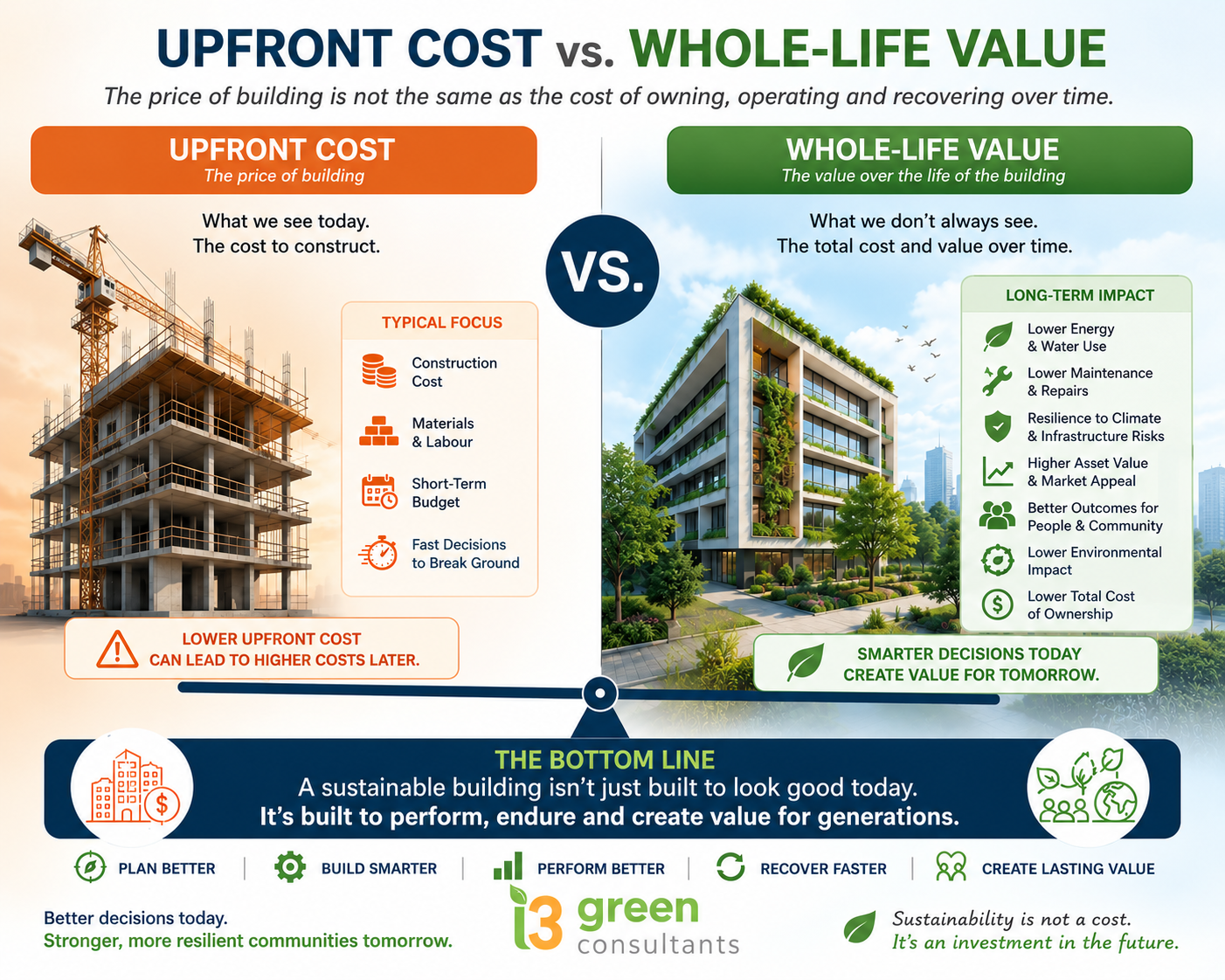
Green building is not necessarily more expensive than conventional construction. While some sustainable features can increase upfront costs, sustainable design can reduce energy, water, maintenance and climate-related costs over a building’s life. The better comparison is therefore not construction price alone, but whole-life cost and value.
The Real Cost of a Building Is More Than Its Construction Price
The initial construction budget tells only part of the story. And sustainability is really about the whole picture.
A building has a life before it is completed – as its individual components and materials – as well as, a life beyond the day it is completed. Post-construction, it consumes energy and water. It requires maintenance. It responds to heat, rainfall, storms and changing climate conditions. It affects the people who occupy it and the communities around it.
It also has to continue functioning when conditions are less than ideal.
That means the true cost of a building is better understood across its whole life cycle—from planning and design through construction, operation, maintenance, adaptation and eventual replacement, repurpose or reuse.
A decision that saves money during construction can sometimes create much greater costs later.
And that is where the economics of sustainable building become much more interesting.
What Happens When We Don’t Design for Resilience?
Consider a building in a Caribbean climate.
A poorly designed building envelope can allow excessive heat gain, increasing the demand for mechanical cooling.
That means higher energy consumption—and potentially higher operating costs for decades; in a region where energy costs are already at a premium.
A site that fails to account for natural drainage patterns can create stormwater problems during intense rainfall. Flash and street flooding are chronic perennial urban challenges faced by many of our capital towns and cities.
A roof that is inadequately designed or protected can become a significant vulnerability during extreme weather. High winds and gusts become more frequent year after year, increasing risk to larger populations..
Critical electrical, mechanical or communications infrastructure that is placed in vulnerable locations can suffer substantial damage during a climate event, at times resulting in marooned or isolated communities for extended periods.
And a development that fails to consider its relationship with surrounding communities can generate social and economic consequences that never appeared on the original project budget.
None of these costs necessarily appear under the heading “green building.” But they are very real costs.
Sustainable Building Is Not Just About Technology
This is one of the biggest misconceptions about sustainable construction.
Sustainable building does not necessarily mean adding expensive technology to a conventional building.
Sometimes sustainability begins with a much simpler question:
Did we make the right decision in the first place?
Where is the building located?
How is the site responding to its natural environment?
What is the orientation of the building?
How does it respond to prevailing winds and solar exposure?
Can daylight and natural ventilation reduce dependence on mechanical systems?
How is stormwater managed?
Are materials appropriate for the local climate?
Can the building withstand increasingly intense weather events?
How much energy and water will it consume during its operational life?
And perhaps most importantly:
Who benefits from the development, and who bears the risks and costs?
These are planning and design questions before they are technology questions.
The Caribbean Context Matters
For Caribbean countries and other Small Island Developing States (SIDS), this conversation is particularly important.
Our buildings operate in environments shaped by heat, humidity, intense rainfall, coastal exposure and extreme weather and geomorphological events.
At the same time, many Caribbean economies face high energy costs, significant dependence on imported materials and equipment, limited resources, and substantial exposure to climate-related risks.
That means sustainability cannot simply be about replicating solutions developed for another climate or another economic context.
We need to ask what works here!
A resilient Caribbean building may involve sophisticated technology—but it may also involve passive design strategies, appropriate site planning, shading, natural ventilation, rainwater management, durable materials, thoughtful orientation and careful infrastructure placement.
The smartest solution is not necessarily the most technologically complicated or advanced one.
Resilience Can Be an Economic Strategy
There is an important economic dimension to resilience that deserves much more attention.
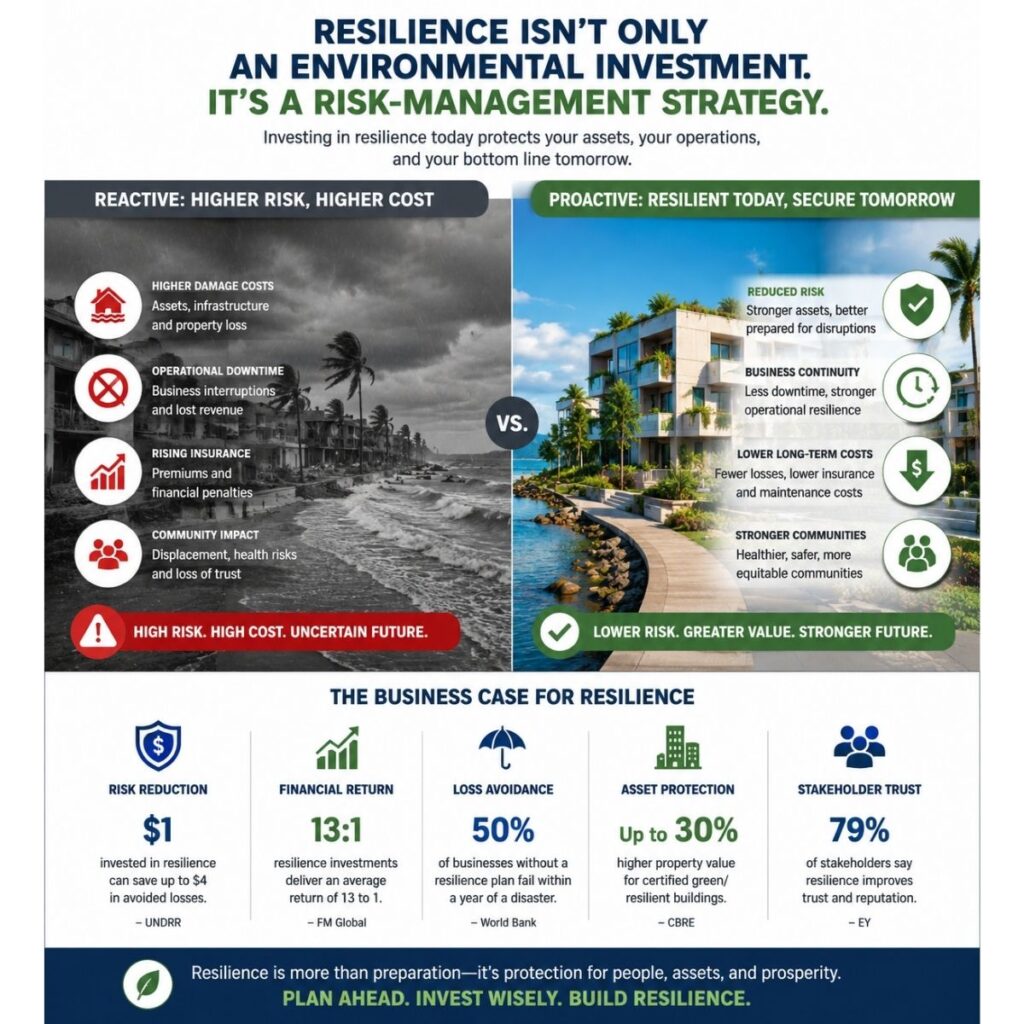
The Inter-American Development Bank has highlighted the potential economic benefits of more resilient construction approaches in the Caribbean, including reduced disaster losses, lower energy consumption and lower emissions.
That matters because resilience is often framed as an environmental issue.
It is also a risk-management strategy.
If a design decision reduces the probability of damage during an extreme event, that can protect the owner’s investment.
If a building uses less energy, that can reduce operating costs.
If passive design reduces cooling requirements, that can improve long-term efficiency.
If better stormwater management reduces flooding risk, that can protect both the property and surrounding infrastructure.
And if a building can continue operating during and after a disruptive event, its value extends beyond the physical structure itself.
This is why the conversation needs to move beyond upfront cost.
Upfront Cost vs. Whole-Life Value
A sustainable building should not be evaluated solely by asking:
“How much did it cost to construct?”
A better set of questions might be:
- How much will it cost to operate?
- How much energy will it consume?
- How much water will it use?
- How frequently will major components need replacement?
- How vulnerable is it to extreme weather?
- What will happen if energy prices increase?
- What happens if climate risks intensify?
- How adaptable is the building?
- What costs could have been avoided through better planning?
- What value does the building create for its occupants and surrounding community?
This is the difference between looking at price and looking at value.
The cheapest building to construct is not necessarily the cheapest building to own.
And the most expensive sustainable feature is not necessarily the most valuable sustainability investment.
The Most Sustainable Decision May Happen Before Construction Begins
This is where sustainability planning becomes particularly powerful.
Some of the highest-value sustainability decisions happen before anyone breaks ground.
A planner, architect, engineer or developer can influence outcomes through decisions about site selection, land use, orientation, density, access, infrastructure, drainage, mobility and relationships with surrounding communities.
Once construction is underway, changing fundamental decisions becomes considerably more expensive. But early in the project, the opportunity to influence outcomes is much greater. That is why I often think of sustainability as a decision-making framework, rather than simply a collection of green technologies.
The objective isn’t to make a project “green” by adding features at the end. It is to make better decisions from the beginning.
Sustainability Planning Connects the Pieces
A building does not exist in isolation.
It sits on a site → The site connects to infrastructure → Infrastructure connects to communities → Communities operate within an economy.
And all of these systems exist within an environment that is changing.
This means sustainable development requires us to look at the bigger picture.
SITE + BUILDING + ENERGY + WATER + MATERIALS + PEOPLE + OPERATIONS = SUSTAINABILITY
When these elements are considered together, sustainability becomes less about buying additional products and more about making better decisions.
That is the value of bringing environmental, economic, spatial and social considerations into the same conversation.
So, Is Green Building Too Expensive?
Sometimes, sustainable features can involve additional upfront investment. We should be honest about that.
But the conversation should not stop there.
The real question is whether that additional investment creates value over the life of the project.
A decision that costs more today but reduces energy consumption for decades may be a smart investment. A resilience measure that reduces potential disaster losses may be a smart investment. A passive design strategy that improves thermal comfort without relying entirely on mechanical cooling may be a smart investment. Better site planning that reduces infrastructure requirements or stormwater risks may be a smart investment.
And sometimes, the most sustainable decision costs very little—or nothing extra at all.
It simply requires making the decision earlier.
The Better Question
So, when someone tells me:
“Green building is too expensive,”
I don’t think the answer should simply be to argue that sustainable construction is cheaper.
The better response is to broaden the conversation.
Let’s ask:
What will this building cost to own?
What will it cost to operate?
What will it cost when energy prices rise?
What will it cost after a major storm?
What will it cost if the site floods?
What will it cost if the building becomes uncomfortable or inefficient?
What will it cost the surrounding community if development decisions create unintended consequences?
And ultimately:
Can we afford to build something that isn’t resilient, efficient and fit for the future?
That is the sustainability conversation I believe we need.
Because sustainable development isn’t simply about spending more money.
It is about spending more intelligently.
It is about understanding risk.
It is about considering whole-life value.
It is about designing for the climate we actually live in.
And it is about recognizing that some of the most important sustainability decisions are made long before construction begins.
Sometimes the most sustainable decision isn’t the most expensive technology.
Sometimes it is simply making a better decision earlier.
Frequently Asked Questions About Green Building Costs
Is green building more expensive than conventional construction?
Green building can sometimes involve higher upfront costs, particularly when projects incorporate specialized technologies, materials or certification requirements. However, sustainable design can also reduce energy, water, maintenance and climate-related costs over the life of a building. The financial value should therefore be evaluated using whole-life cost rather than construction cost alone.
What is the biggest financial benefit of sustainable building?
There is no single benefit that applies to every project. Potential benefits include lower energy and water consumption, reduced operating costs, improved durability, reduced exposure to climate-related losses, improved occupant comfort and greater long-term asset resilience.
Can sustainable buildings be affordable?
Yes. Sustainable building does not automatically require expensive technology. Early-stage decisions involving site selection, orientation, shading, natural ventilation, daylighting, stormwater management and passive design can significantly influence building performance without necessarily requiring major additional capital expenditure.
Why is resilience important in Caribbean building design?
Caribbean buildings face risks associated with heat, intense rainfall, storms, flooding and other climate-related hazards. Designing for resilience can help reduce damage, maintain building functionality and protect long-term investment.
What is whole-life cost in building design?
Whole-life cost considers the financial implications of a building across its life cycle, including initial construction, energy and water consumption, maintenance, repairs, replacement of components, adaptation and other operational costs. It provides a broader picture of the financial performance of a building than its initial construction price.
What does sustainability planning mean?
Sustainability planning integrates environmental, economic, spatial and social considerations into development decisions. It helps projects address issues such as site suitability, resource efficiency, resilience, infrastructure, community impacts and long-term value from the earliest stages of planning and design.
The i3 Green Perspective
At i3 Green Consultants, we believe sustainability should not be an afterthought added to a project once the major decisions have already been made. It should be part of the decision-making process from the beginning. Because when sustainability is integrated into planning, design and development, the goal isn’t simply to create a building with more “green” features. Get in touch to explore exactly how we can do this for you. Contact Us
The goal is to create places that are more resilient, more efficient, more responsive to their context and better prepared for the future.
And that is a very different proposition from simply asking:
“How much does green building cost?”
The better question is:
“What value can better decisions create over the life of the project?”