
Before You Build, Ask Better Questions: 7 Questions for More Sustainable Development
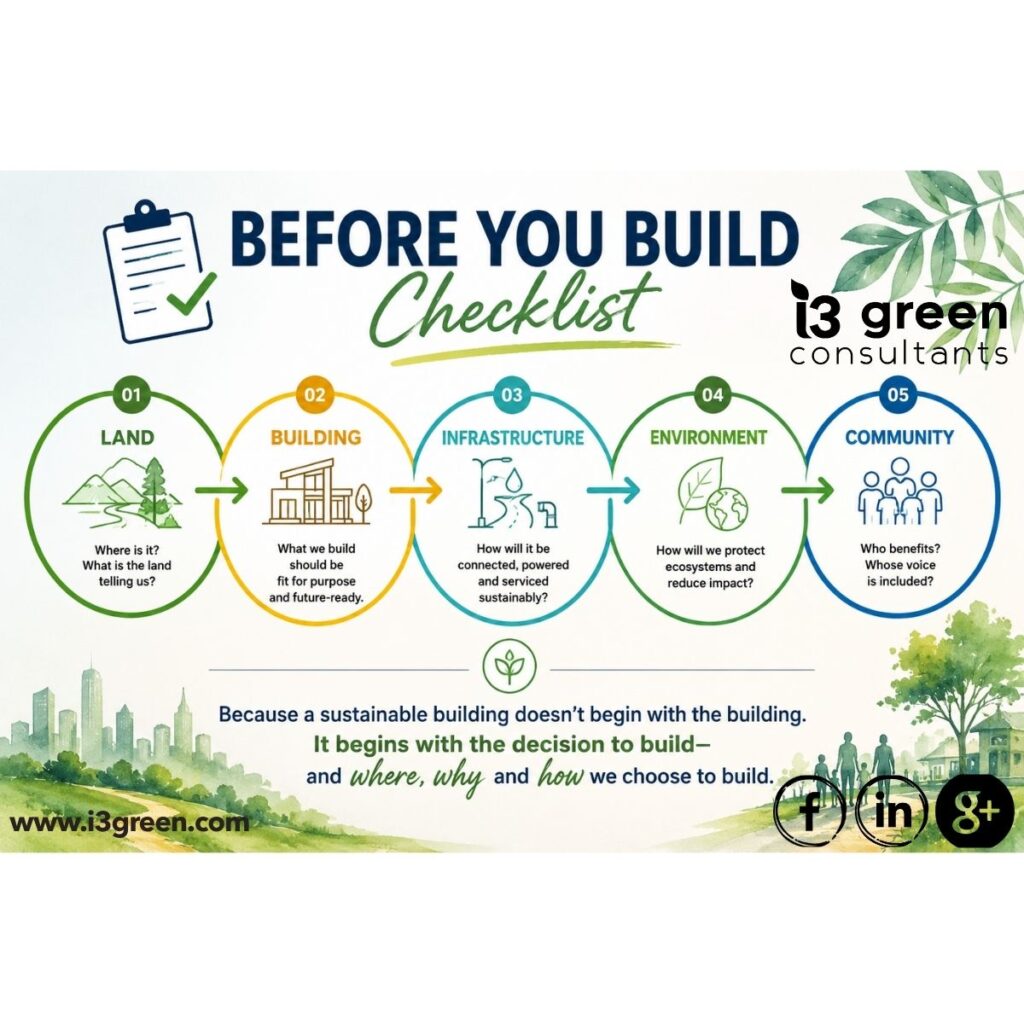
Sustainable development does not begin when the architect starts drawing; it begins with the decision to build.
Before the first foundation is designed, the first material is specified, or the first sustainability certification is considered, there are bigger questions that deserve attention.
- Is this the right place to build?
- What climate risks does the site face?
- Can the development work with the natural environment rather than against it?
- Will existing infrastructure be able to support it?
- Who will benefit from the development—and who might be affected by it?
These questions may sound simple, but they can fundamentally change the outcome of a project.
Too often, sustainability enters the development process after many of the most consequential decisions have already been made. By that point, the site has been selected, the building footprint established, infrastructure requirements identified and significant design choices locked in.
That is why I believe sustainability planning must begin before the building is designed.
My approach, as The Sustainability Planner, is to look beyond the building itself and consider the relationship between land, buildings, infrastructure, environmental systems and communities. Because a sustainable building on an unsuitable site does not necessarily create sustainable development.
What is sustainable development planning?
Sustainable development planning is the process of integrating environmental, social, economic, spatial and resilience considerations into development decisions from the earliest stages of a project.
In practical terms, it means asking not only “How do we build this building more sustainably?” but also:
“Should we build here, how should we build, what systems will the development depend on, and how can it create long-term value for people and place?”
This distinction is important.
Green building tends to focus heavily on the performance of a building—energy, water, materials, indoor environmental quality and related considerations.
Sustainable development planning takes a wider view.
It considers the site, surrounding environment, infrastructure, land-use patterns, mobility, community needs, climate risks and long-term impacts alongside the building itself.
The best outcomes occur when these considerations are connected rather than treated as separate checklists.
Why should sustainability be considered before building design?
The earlier sustainability is incorporated into a development project, the more opportunities there are to influence fundamental decisions about the site, layout, infrastructure, resource use and resilience.
Once construction begins, changing those decisions can become expensive, disruptive or impossible.
Consider something as basic as building orientation.
The way a building is positioned can influence solar exposure, natural ventilation, shading opportunities, energy demand and occupant comfort. If orientation is considered early, it can become part of the architectural concept. If it is considered later, the project may need to compensate through mechanical systems, additional technologies or costly design changes. Just think of how many homes are now designed automatically with AC units, here; in the coastal tropics where the NE trades dominate.
The same principle applies to stormwater.
It is very different to ask: “How do we drain this site?”
than to ask: “How can the development manage rainfall as part of the site’s natural water system?”
The first question focuses on solving a problem. The second asks whether the problem can be reduced through better planning and design in the first place.
That is the power of early sustainability planning.
7 Questions to Ask Before You Build
Is this the right place for this development?
The first sustainability question is not about the building. It is about the land.
Before committing to a development site, it is important to understand its physical, environmental, social and planning characteristics.
Questions might include:
- What is the existing land use?
- Is the proposed use compatible with surrounding development?
- What are the site’s topography and drainage characteristics?
- Are there environmentally sensitive areas nearby?
- How accessible is the site?
- What transportation options are available?
- What utilities and services already exist?
- What planning policies and regulations apply?
- Could the development encourage inappropriate expansion into environmentally sensitive areas?
Site selection is one of the most consequential sustainability decisions a development team can make.
A building can be highly energy efficient, use sustainable materials and incorporate renewable energy—and still create negative environmental or social outcomes if it is poorly located.
Sustainability begins with making good decisions about where development happens.
What climate risks does the site face today—and what could it face tomorrow?
Climate resilience should not be treated as an optional feature added after a project is designed.
It should be part of the initial site assessment.
Depending on location, a development may need to consider risks such as:
- Flooding
- Extreme rainfall
- Coastal erosion
- Sea-level rise
- Extreme heat
- Drought and water scarcity
- Strong winds and hurricanes
- Landslides
- Wildfire
- Power and infrastructure disruptions
For Caribbean development, these questions are particularly important.
Small island developing states face a combination of environmental, infrastructure and economic vulnerabilities that can amplify the consequences of climate-related events.
A resilient development therefore needs to consider more than whether the building can withstand a storm.
It should also ask:
- What happens to access roads?
- What happens if electricity is interrupted?
- What happens to water supplies?
- Can stormwater systems cope with extreme rainfall?
- Can people safely reach and leave the development?
- How quickly can the development recover after a disruption?
This is why I see climate resilience as a risk-management strategy—not simply an environmental objective.
How can the site work with natural systems rather than against them?
One of the most valuable sustainability opportunities may already exist on the site.
It could be a mature tree canopy.
A natural drainage path.
A wetland.
A slope.
A coastal ecosystem.
A vegetated area.
A prevailing wind pattern.
Or simply the site’s natural relationship with sunlight and rainfall.
The conventional approach to development can be to clear, level, channel and control these systems.
A more sustainable approach asks: What if we worked with them?
- Natural systems can provide valuable functions.
- Vegetation can provide shade and reduce heat.
- Healthy soils can support infiltration.
- Wetlands can help manage water.
- Trees can contribute to biodiversity and microclimate regulation.
- Building orientation and openings can take advantage of prevailing breezes.
- Shading and landscape design can reduce exposure to heat.
These are not merely aesthetic considerations. They can become part of the development’s environmental and resilience infrastructure. The goal is not to prevent development but to find ways for development and natural systems to coexist more intelligently.
What infrastructure will the development require?
A development does not exist in isolation. Every building depends on systems beyond its property boundary.
- Water.
- Electricity.
- Roads.
- Drainage.
- Waste management.
- Telecommunications.
- Transportation.
- Public services.
The sustainability of a development therefore depends partly on the capacity and resilience of the infrastructure that supports it.
Before building, development teams should ask:
Can existing infrastructure support the proposed development?
And if not:
What additional infrastructure will be required—and what will be the environmental, economic and social implications?
This is particularly important when development occurs in areas where infrastructure capacity is already constrained like in many of our Caribbean urban centres.
A project that looks sustainable within its property boundary may create additional pressure on surrounding systems. This is why land-use planning, infrastructure planning and sustainability planning need to be connected.
How can we reduce energy, water and material demand from the outset?
Sustainable construction is not simply about adding technology to a building. Sometimes the most effective sustainability strategies are the simplest (low-tech) ones.
For example:
- Good orientation can reduce solar heat gain.
- Shading can improve thermal comfort.
- Natural ventilation can reduce dependence on mechanical cooling.
- Efficient fixtures can reduce water consumption.
- Rainwater management can reduce pressure on drainage systems.
- Durable materials can reduce replacement and maintenance requirements.
- Thoughtful material selection can reduce environmental impacts over the building’s life cycle.
The key is to think about resource efficiency before selecting technologies. So instead of asking:
“What technology can we add to make this building greener?”
Ask:
“How can we design the building so that it needs fewer resources in the first place?”
That shift—from technological solutions alone to passive design and integrated performance—can be particularly valuable in tropical climate and Caribbean contexts.
Who will use this development—and whose needs might we be overlooking?
This may be one of the most important sustainability questions of all.
A development can perform extremely well environmentally and still fail people.
- Who is the development designed for?
- Who will use it?
- Who lives nearby?
- Who works there?
- Who needs to access it?
- Who might experience changes to traffic, drainage, noise, public space or access as a result?
And perhaps most importantly:
- Who was involved in shaping the decisions?
Sustainable development is not only about reducing environmental impacts. It is also about creating places that are inclusive, accessible, functional and responsive to community needs.
Community engagement should therefore be more than a procedural requirement. Local knowledge can reveal issues that may not appear in technical assessments or desktop research. Residents may understand drainage patterns, access challenges, flooding history, transportation problems or social dynamics that are invisible on a site plan. Listening early can lead to better decisions later.
How will this project contribute to the wider community—not just the project boundary?
A development project should be evaluated by more than what happens inside its property line.
Consider the wider questions:
- Does it improve or restrict connectivity?
- Does it create employment opportunities?
- Does it support local businesses?
- Does it improve public spaces?
- Does it contribute to community resilience?
- Does it protect important environmental assets?
- Does it improve access to services?
- Does it strengthen rather than burden existing infrastructure?
- Does it create long-term value for the surrounding area?
This is where sustainability becomes a development strategy rather than simply a building strategy.
The objective is not merely to create a building that performs well. It is to create development that contributes positively to the place in which it exists.