
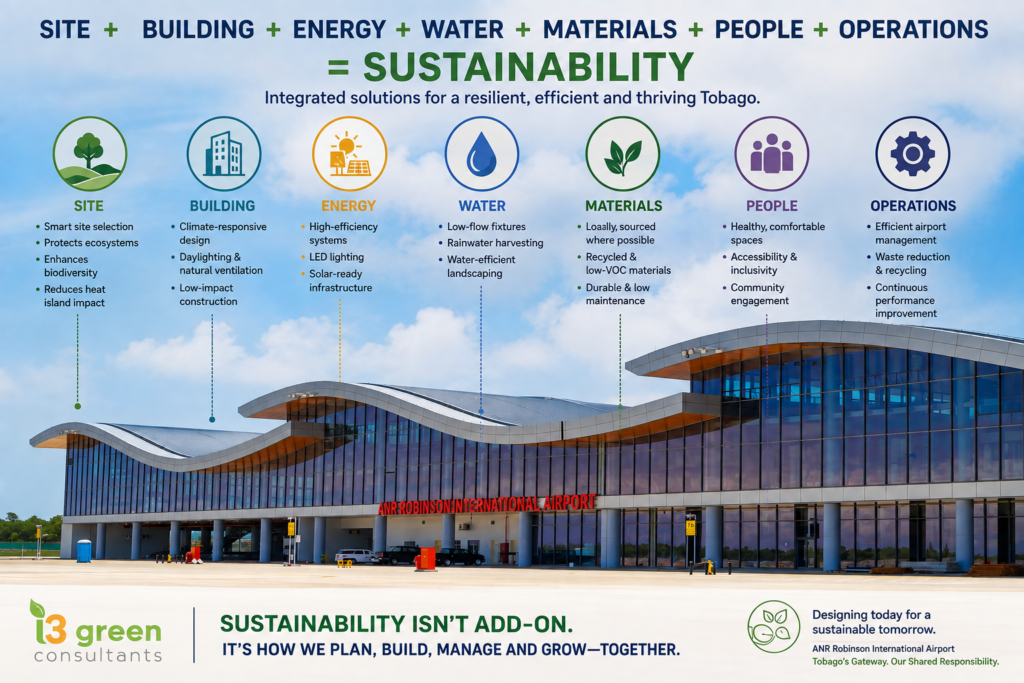
What Does an Airport Have to Teach Us About Sustainable Development?
More than you might think.
When we talk about sustainable development, the conversation often focuses on individual buildings, technologies or environmental features.
- Solar panels.
- Energy-efficient lighting.
- Water-saving fixtures.
- Green materials.
- Efficient air-conditioning systems.
All of these things matter. But they are only pieces of a much larger puzzle.
True sustainability is not about making one component of a project “green.” It is about understanding how site, building, infrastructure, energy, water, materials, people and operations interact as a system.
Few projects demonstrate this better than an airport.
And my experience working as a LEED & Sustainability Planning Consultant on the ANR Robinson International Airport terminal project in Tobago gave me a front-row seat to exactly what integrated sustainability can look like in practice.
An Airport Is Much More Than a Building
An airport terminal may look like a building project. But functionally, it is an interconnected piece of infrastructure.
It has to move thousands of people efficiently. It has to accommodate complex transportation systems. It has to manage significant energy and water demands. It has to provide safe, comfortable and accessible spaces. It has to respond to its local climate. It has to consider materials, construction, waste and operations.
And it doesn’t operate in isolation.
An airport connects to roads, public transportation, utilities, surrounding communities, tourism, local economic activity and national infrastructure.
That means decisions made during the planning and design of an airport can have consequences far beyond the footprint of the terminal itself.
This is the fundamental lesson: sustainable development requires us to look at the whole system—not just the individual building.
Sustainability Isn’t a Feature; It’s a Process.
One of the biggest misconceptions about green building is that sustainability can be added to a project near the end.
The building is designed.
The construction budget is established.
The systems are selected.
The materials are specified.
And then someone asks: “What can we do to make this project sustainable?”
By that point, many of the most important decisions have already been made.
Sustainability works differently.
It begins much earlier—with questions about where we build, why we build, how we build and how the development will function over its entire life cycle.
For an airport, those questions become particularly important.
- How does the building respond to the local climate?
- How can energy demand be reduced?
- How can water resources be managed more efficiently?
- How can indoor environmental quality support occupants?
- What materials are being used and where do they come from?
- How can construction impacts be reduced?
- How will the facility operate once construction is complete?
- How does the project connect with the surrounding transportation and infrastructure network?
And perhaps most importantly:
- How do all these decisions work together?
That is where integrated sustainability planning becomes powerful.
The Importance of Bringing Disciplines Together
Sustainable development cannot be delivered effectively by one profession working alone.
- Planners see the relationship between development, land use, infrastructure and communities.
- Architects shape the building and its relationship with place.
- Engineers design the systems that make the building function.
- Contractors translate plans into physical reality.
- Operators understand what happens after the project is completed.
- Communities experience the impacts of development.
- Decision-makers determine priorities, policies and investment.
Each perspective is important.
But sustainability becomes significantly more effective when those perspectives are brought together early in the process. Instead of asking each discipline to solve sustainability problems independently, the team can begin asking a shared question:
How can we make this project work better for people, place and planet?
That question changes the conversation. It moves sustainability away from being a checklist and toward becoming a framework for better decision-making.
What the Tobago Airport Taught Me About Green Building
Working on the ANR Robinson International Airport terminal in Tobago reinforced something I have come to believe strongly throughout my work:
The best sustainability outcomes are often created through integration rather than individual interventions.
A high-performance building is not simply the result of installing efficient equipment. It is the result of hundreds of interconnected decisions.
- The site matters.
- The orientation matters.
- The building envelope matters.
- Energy systems matter.
- Water systems matter.
- Material choices matter.
- Indoor environmental quality matters.
- Construction practices matter.
- Operations matter.
- And the people using the building matter.
This is particularly important in the Caribbean, where our buildings and infrastructure must respond to a distinctive combination of climate hazards, resource constraints, economic realities, environmental vulnerability and community needs.
A sustainability strategy that works somewhere else cannot simply be copied and pasted into the Caribbean. It has to respond to our place.
Why This Matters for Caribbean Development Futures
The Caribbean is already experiencing many of the pressures that make integrated sustainability planning increasingly important.
- Climate risks are influencing infrastructure decisions.
- Energy costs affect the operation of buildings and businesses.
- Water security is becoming an increasingly important consideration.
- Tourism destinations are under pressure to protect the natural assets that attract visitors.
- Governments and developers must make significant infrastructure investments while managing limited resources.
- And communities increasingly expect development to deliver broader social and economic value.
This means sustainability cannot be reduced to environmental performance alone.
A genuinely sustainable project must consider questions of:
- Environmental performance
- Economic value
- Social outcomes
- Resilience
- Resource efficiency
- Health and wellbeing
- Long-term operational performance
- Community impact
These dimensions are connected.
For example, reducing energy demand isn’t only an environmental decision. It can also reduce operating costs and improve resilience to energy price volatility.
Improving water efficiency isn’t only about conservation. It can also reduce operating costs and strengthen resilience where water resources are constrained.
Designing for climate responsiveness isn’t simply an environmental strategy. It can influence occupant comfort, energy consumption, operational costs and resilience.
That is what integrated sustainability looks like.
The Plaque Is Not the Point
The ANR Robinson International Airport terminal went on to receive LEED certification, representing an important milestone for Tobago and the wider Caribbean.
And yes, certification matters. It provides a framework for measuring performance and demonstrates that sustainability objectives have been incorporated into the project.
But for me, the most important lesson wasn’t the plaque.
It was the process that made the plaque possible.
Certification is the visible outcome. The real work happens much earlier.
It happens in the meetings.
In the planning decisions.
In the design reviews.
In the conversations between disciplines.
In the questions asked about materials, energy, water, waste and occupant wellbeing.
In the decisions about how the building will operate.
And in the willingness of a project team to look beyond individual disciplines and consider the project as a whole.
That is where sustainable development becomes meaningful.
From Green Buildings to Better Infrastructure
This is also why I believe we need to broaden the way we talk about green building.
A sustainable building is important.
But a sustainable building within an unsustainable development pattern presents a much more complicated picture.
We need to consider the relationship between the site, building, infrastructure, environment, community and economy.
The question should not simply be:
“Is this building green?”
We should also be asking:
- “Does this development make sense for this place?”
- “Does it use resources responsibly?”
- “Does it improve resilience?”
- “Does it create value over the long term?”
- “Does it work for the people who use it?”
- “Does it contribute positively to the surrounding community?”
And ultimately:
- “Does this project help create a more sustainable system?”
Those are much bigger questions. And they require us to think beyond buildings.
What Sustainable Development Really Means
My experience on the airport project reinforced a simple principle that continues to shape my work as Petal, The Sustainability Planner:
Sustainability isn’t about making one thing green. It is about making the whole system work better.
That means bringing sustainability into planning and decision-making from the beginning—not treating it as an add-on at the end.
It means creating stronger conversations between planners, architects, engineers, contractors, operators, communities and decision-makers.
It means recognizing that environmental, economic and social outcomes are interconnected.
And it means designing solutions that respond to the realities of the places where we live and build.
For Caribbean countries and small island developing states (SIDS) in particular, this integrated approach isn’t simply desirable.
It is essential.
Because the infrastructure we build today will shape how our communities function, how much resources they consume, how resilient they are and what opportunities they create for future generations.
An airport taught me that sustainability is much bigger than a building.
It is about connections.
- Between people and place.
- Between planning and design.
- Between infrastructure and community.
- Between environmental responsibility and economic value.
- And ultimately, between the decisions we make today and the future we are creating.
That is the real opportunity of sustainable development.
Not simply to build greener buildings.
But to create better places, better infrastructure and better systems for people and planet.
What about your project?
Have you seen a project where sustainability was genuinely integrated into planning, design and operations rather than treated as an afterthought?
What did that integration make possible?