
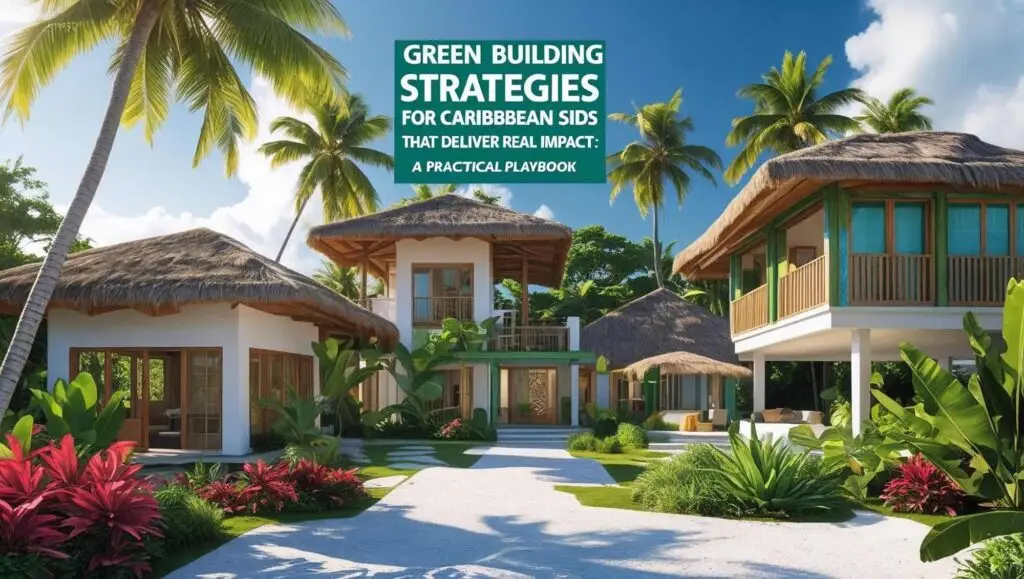
Green Building Strategies for Caribbean SIDS that Deliver Real Impact: A Practical Playbook
Executive Summary
Green building is a vital strategy for Small Island Developing States (SIDS) due to their high vulnerability to climate change impacts, even though they contribute minimally to global greenhouse gas (GHG) emissions. This approach is not merely an environmental choice but an economic and public health necessity, offering significant operational savings and improved asset value. Green buildings are no longer a niche—they’re a proven pathway to lower operating costs, reduced carbon, healthier occupants, and resilient assets. Across rating systems such as Leadership in Energy & Environmental Design (LEED), BREEAM, Green Globes, WELL, Fitwel, Arc, IFC’s Edge, and the Living Building Challenge (LBC), the most effective strategies coalesce around: deep energy efficiency and electrification; low-carbon materials and circularity; high-performance water systems; indoor environmental quality (IEQ) backed by measurement; biophilic, people-first design; and data-driven operations. Evidence from the U.S. Green Building Council (USGBC) and the World Green Building Council (World GBC) shows material, quantifiable benefits—lower energy and water use, reduced absenteeism, improved productivity, and large avoided emissions at portfolio scale. (usgbc.org, worldgbc.s3.eu-west-2.amazonaws.com, World Green Building Council)
Why green buildings matter right now
Buildings are a major lever for climate and health. USGBC cites independent analyses showing LEED projects typically use ~25% less energy, 11% less water, and emit ~34% less CO₂ relative to comparable conventional buildings, with compelling OPEX savings and asset-value upside. LEED retrofits have also been associated with nearly 10% reductions in operating costs within the first year, and maintenance costs ~20% lower than typical buildings. (usgbc.org)
At the systems level, USGBC’s recent Impact Report summarizes more than 120 million metric tons of CO₂ avoided across LEED projects to date—evidence that rigorous standards can scale climate impact across markets and typologies. (usgbc.org)
On the human side, World GBC’s Better Places for People research base links better IEQ—air quality, daylight, acoustic comfort, thermal control, and access to nature—to measurable gains in health, satisfaction, and productivity. The insight is consistent across office and retail environments: greener, healthier buildings support people and performance. (World Green Building Council)
Finally, as operational energy decarbonizes, embodied carbon in materials moves to centre stage. World GBC’s landmark Bringing Embodied Carbon Upfront calls for at least 40% embodied-carbon reductions by 2030 for new buildings and renovations, and net-zero embodied carbon by 2050—guidance that directly informs your materials and design decisions today. (worldgbc.s3.eu-west-2.amazonaws.com)
Why Green Building is Mission-Critical for SIDS
Small Island Developing States (SIDS) contribute less than 1% of global GHG emissions, yet face outsized risks from sea-level rise, stronger tropical cyclones, storm surges, heat, and water stress. This isn’t abstract: the IPCC finds these impacts are already detectable across natural and human systems on small islands, with very high confidence. (United Nations, IPCC)
For our Caribbean SIDS, green building is not just “nice to have”; it’s an economic and public-health necessity. The business case is strong too: USGBC and World GBC summarize consistent evidence that certified green buildings reduce operating costs (energy, water, O&M) and can command rent/value premiums. (U.S. Green Building Council, World Green Building Council, CBRE)
Climate & Context First: A Tropical Design Mindset
Hot-humid and marine conditions shape everything in SIDS:
- Peak solar gain + high humidity → prioritize shade, airflow, and moisture control.
- Salt-laden air + hurricanes → robust, corrosion-resistant, impact-rated envelopes.
- Intermittent grids + diesel reliance → efficiency first, then distributed renewables + storage.
- Water scarcity + flash flooding → integrated water cycles (capture, reuse) and green/blue infrastructure.
- Ocean and reef health → nature-positive siting, low-impact outfalls, and material choices.
IPCC’s small islands chapter and recent SIDS briefs reinforce these risks and the need for adaptation and resilience at building scale. (IPCC, UNDP Climate Promise)
Framework Overview: What Each Rating System Emphasizes
- LEED (USGBC/GBCI): A global framework for designing, constructing, and operating buildings, interiors, and communities. LEED v4.1 and the emerging v5 emphasize carbon, resilience, health, and equity, with credits spanning Energy, Water, Materials, IEQ, Site and Transportation, and Integrative Process. (U.S. Green Building Council)
- BREEAM: A comprehensive, evidence-based system with categories including Energy, Water, Health & Wellbeing, Transport, Materials, Waste, Pollution, Land Use & Ecology, Management, Innovation, and Resilience—with lifecycle coverage from new construction to in-use. (BREEAM)
- Green Globes (GBI): A flexible, assessor-guided program scoring projects across Project Management, Site, Energy, Water, Materials, and Indoor Environment, on a 1,000-point scale with transparent criteria and on-site verification. (Green Building Initiative)
- WELL (v2): A performance-based standard focused on people’s health and well-being across 10 concepts (Air, Water, Nourishment, Light, Movement, Thermal Comfort, Sound, Materials, Mind, Community). (WELL Resource Hub)
- Fitwel: Evidence-based health strategies scored across seven research-derived Health Impact Categories (e.g., physical activity, wellbeing, social equity). Credit points align with actionable policies, design strategies, and operations, particularly strong for portfolios and existing buildings. (fitwel.org)
- Arc* (GBCI): A performance-measurement platform scoring energy, water, waste, transportation, and human experience and enabling continuous improvement and cross-portfolio benchmarking—useful for disclosure, investor communication, and LEED O+M integration. (gbci.org)
- EDGE* (IFC): Designed for emerging markets; 20% savings in energy, water, and embodied energy in materials minimum; “Advanced” at ≥40% energy savings; Zero Carbon tier available. (EDGE Buildings, EDGE)
- Living Building Challenge 4.0: The most ambitious regenerative framework, organized into seven Petals—Place, Water, Energy, Health + Happiness, Materials, Equity, Beauty—and 20 Imperatives measured via actual, post-occupancy performance. (Living Future – A future worth living in)
*used in conjunction
Strategy 1 — Passive Cooling & Envelope Resilience (Energy + Health + Risk)
What to do
- Orient, shade, ventilate: Elongate east-west, deploy deep overhangs, verandas, fins, operable windows/louvers, light-coloured/high-albedo roofs, and cross-ventilation paths.
- Moisture management: Vapor-open assemblies where appropriate; robust air-sealing; capillary breaks; mould-resistant finishes; dedicated dehumidification.
- Hurricane/storm-ready: Impact-rated glazing/shutters, continuous load paths, corrosion-resistant fasteners, roof uplift detailing, flood-resistant ground floors.
How it maps
- LEED: EA Optimize Energy Performance; SS Heat Island Reduction; EQ Enhanced Ventilation/Low-Emitting; Integrative Process for envelope/thermal analysis. (U.S. Green Building Council)
- BREEAM: Energy, Health & Wellbeing, Management, Pollution (resilience). (Knight Frank)
- Green Globes: Energy (envelope), IEQ, Site (exposure). (Conservice ESG)
- EDGE: Passive cooling options drive ≥20% energy reduction; “Advanced” at ≥40% energy. (EDGE Buildings)
- LBC: Energy and Health + Happiness Petals—natural ventilation and daylight as baselines.
- WELL: Air, Thermal Comfort, Light, Sound—comfort and IAQ benefits of ventilation & humidity control. (WELL Resource Hub)
Impact snapshot: Energy-efficient, certified buildings consistently report lower operating energy; USGBC cites average energy reductions and cost savings in LEED buildings. In hot-humid climates, passive design often yields the fastest paybacks. (U.S. Green Building Council)
Strategy 2 — Net-Zero-Ready Systems: Efficient Cooling, Smart Controls & Renewables
What to do
- High-efficiency mechanicals: Variable-speed heat pumps/chillers; dedicated outdoor air systems (DOAS) with energy recovery; demand-controlled ventilation; ERV with anti-corrosion coils.
- Smart controls: Zonal setpoints, adaptive thermal bands, occupancy-based ventilation/lighting.
- Rooftop PV + battery: Solar-plus-storage that rides through outages; consider microgrids for districts; prioritize critical loads (fridges, comms, pumps).
- SWAC/district cooling (where feasible): Seawater air conditioning or harbour-water loops for large resorts/hospitals.
How it maps
- LEED: EA Optimize Energy Performance; Grid Harmonization; On-site renewables. (U.S. Green Building Council)
- BREEAM: Energy; Pollution (refrigerants); Management (commissioning). (Knight Frank)
- Green Globes: Energy; Site (microgrid context). (Conservice ESG)
- EDGE: Energy measures to meet 20% / 40%+ thresholds; Zero Carbon pathway. (EDGE Buildings, EDGE)
- Arc: Performance scores reflect measured energy & carbon over time. (World Green Building Council)
- LBC: Energy Petal requires net positive; use as a long-term north star.
Strategy 3 — Water Security: Harvest, Reuse, Recharge
What to do
- Rainwater: Right-size roofs and cisterns; first-flush diverters; UV/filtration for potable use (where permitted).
- Reuse: Greywater to toilets/irrigation; tertiary-treated blackwater for landscaping; smart irrigation with soil moisture sensors; native, xeric or salt-tolerant species.
- Stormwater: Green roofs, bioswales, permeable paving, mangrove/reef-safe outfalls; avoid thermal/chemical shock to nearshore ecosystems.
How it maps
- LEED: WE credits for indoor/outdoor water reductions; SS Rainwater Management. (U.S. Green Building Council)
- BREEAM: Water; Land Use & Ecology; Pollution; Waste (construction water). (Knight Frank)
- Green Globes: Water; Site (runoff). (Conservice ESG)
- EDGE: ≥20% water savings is core. (EDGE Buildings)
- LBC: Water Petal—net positive water; treat and reuse on site.
- WELL: Water concept requires testing/filtration protocols that are crucial with cisterns. (WELL Resource Hub)
Strategy 4 — Materials & Embodied Carbon: Build Light, Local & Low-Toxicity
What to do
- Structure: Optimize spans and cement content; specify SCMs (e.g., slag), low-carbon concretes; responsibly sourced timber; modular/prefab to cut waste.
- Finishes: Low-VOC, moisture-resistant, repairable; saline-resistant coatings; avoid harmful chemistries.
- Local value chains: Favour local & regional materials to reduce transport emissions and build resilience.
How it maps
- LEED: MR credits for EPDs, recycled content, local sourcing; Low-Emitting Materials in IEQ. (U.S. Green Building Council)
- BREEAM: Materials; Waste; Pollution (construction). (Knight Frank)
- Green Globes: Materials; Emissions/IEQ. (Conservice ESG)
- EDGE: Embodied energy in materials ≥20% reduction is required. (EDGE Buildings)
- LBC: Materials Petal—Red List avoidance and transparency.
- World GBC guidance: “Bringing Embodied Carbon Upfront” calls for ~40% reduction by 2030 and net-zero by 2050—use this as a procurement baseline. (U.S. Green Building Council)
Strategy 5 — Health, Wellbeing & Productivity in the Tropics
What to do
- Humidity-aware IAQ: Dehumidification + ventilation to curb mould/allergens.
- Daylight without glare/heat: External shading + high-performance glazing; daylighting controls.
- Acoustics: Typhoon-resilient glazing with acoustic interlayers where needed.
- Active design: Stairs first, shaded walking loops, showers/lockers to encourage active mobility.
- Food & community: Support nourishing food access; culturally relevant spaces to support mental health during/after storms.
How it maps
- WELL: 10 concepts from Air to Community—design & operations to improve sleep, cognition, and overall health. (WELL Resource Hub)
- Fitwel: Strategies tie to Seven Health Impact Categories; flexible for mixed-use/tourism/healthcare. (fitwel.org)
- LEED: IEQ (ventilation, low-emitting materials, daylight), Location & Transportation (active mobility). (U.S. Green Building Council)
Impact snapshot: World GBC’s health and productivity research shows that daylight, good IAQ, and thermal comfort improve cognitive performance and reduce absenteeism—key for island economies with tight labour markets. (World Green Building Council)
Strategy 6 — Performance Management & Recertification
What to do
- Commissioning + Measurement & Verification (M&V): Tropical humidity magnifies control drift. Commission seasonally, tune economizers and latent controls, and track kWh/Litres/IAQ continuously.
- Use Arc platform: Score and publicly demonstrate performance in metrics: energy, water, waste, transport, and human experience. Pursue Arc Performance Certificates to keep teams accountable. (World Green Building Council)
- Re-certify: Green Globes (recommended ~5-year cycle), LEED O+M, WELL Performance Rating. This creates a culture of continuous improvement. (Conservice ESG)
Strategy 7 — Coastal Ecology & Nature-Positive Design
What to do
- Protect blue-green assets: Mangroves, dunes, reefs, seagrass beds; employ living shorelines and coastal setbacks.
- Low-impact lighting: Protect sea turtles and bird life; warm-spectrum, shielded fixtures.
- Stormwater quality: Reef-safe materials; bio-retention planted with native species.
How it maps
- LEED: SS credits (Rainwater Management, Heat Island Reduction, Light Pollution Reduction). (U.S. Green Building Council)
- BREEAM: Land Use & Ecology; Pollution; Water. (Knight Frank)
- LBC: Place and Water Petals—explicitly nature-positive.
Which System Should You Use in SIDS?
Well, the short answer is it depends. An important but often overlooked consideration in pursuing certification is cost. Remember, there are administrative costs associated with certifying a project according to any green building system. These financial commitments must be included for seamless project administration and certification. Additionally, there are other factors which will determine/guide the final choice of rating system to pursue. Ultimately, however, implementing the strategies common to most rating systems, even within the confines of your particular circumstances and context, will improve a project’s overall sustainability.
- EDGE is often the fastest/leanest path for new builds in emerging markets (tourism, housing, small commercial), thanks to the simple 20%-20%-20% threshold and cost-effective measures; it’s region-calibrated and affordable. (EDGE Buildings)
- Arc is the Edge platform for ongoing performance and storytelling. (World Green Building Council)
- LEED v4.1 is a comprehensive, globally recognized framework—great when you need market credibility with investors/brands and want deep energy/water + materials governance. (U.S. Green Building Council)
- BREEAM is strong for portfolio comparability and whole-asset assessment in multinational contexts. (Knight Frank)
- Green Globes can be nimble for existing buildings and O&M upgrades, with practical assessor input. (Conservice ESG)
- WELL/Fitwel layer health and productivity—high-value for tourism, offices, healthcare, and education in hot-humid climates. (WELL Resource Hub, fitwel.org)
- LBC sets a regenerative vision—ambitious pilots (campuses, ecolodges) can pull local supply chains forward.
A SIDS-Focused Implementation Roadmap
1) Set targets
Adopt EDGE Advanced (≥40% energy) or LEED Gold minimum for new builds; require WELL features critical to IAQ, thermal comfort, and water quality; align with World GBC’s 2030 embodied carbon reduction trajectory. (EDGE, U.S. Green Building Council)
2) Design charrette (Integrative Process)
Bring planners, architects, MEP, ecologists, operators, and local craft/trades together. Use climate files and daylight modelling to optimize shading, airflow, and moisture control—this is a LEED Integrative Process best practice. (U.S. Green Building Council)
3) Passive first
Lock in orientation, shading, natural ventilation pathways, and envelope moisture control. Consider raised floors or floodable ground levels in surge zones.
4) Right-size systems
High-Seasonal Energy Efficiency Ratio (SEER) cooling, Dedicated Outdoor Air Systems (DOAS) with energy recovery, and smart controls tuned for high humidity. Use non-ozone-depleting, low-global warming potential (GWP) refrigerants.
5) Water master planning
Model multi-source water supply: rain + municipal + desal (if needed) with reuse. Protect receiving waters with green infrastructure.
6) Materials & supply chain
Write Environmental Product Declarations (EPDs) /Health Product Declarations (HPDs)/Red List requirements into design specifications; encourage local fabrication; pilot low-carbon concrete submittals.
7) Resilience & microgrids
PV + batteries sized for critical loads, hurricane-rated racking, protector Balance of System (BOS), and black-start capability. Consider community-scale microgrids in tourism clusters.
8) Commissioning & training
Emphasize latent load control (dehumidification) and mould prevention. Train facility management teams; establish spare-parts and corrosion management plans.
9) Measure with Arc
Connect meters/sensors for energy, water, waste, transport, and human experience; publish results; target Performance Certificates annually. (World Green Building Council)
10) Re-invest
Use operating savings to fund re-certification and deeper retrofits; publicize benefits to attract climate finance and ESG-minded hospitality brands. (Conservice ESG)
Conclusion: From “Less Harm” to “Net Benefit”
For SIDS on the frontline of climate impacts, green building is a resilience strategy, a health intervention, and a competitiveness play.
- Start with passive cooling and durable envelopes, add high-efficiency systems and renewables + storage, secure water with capture and reuse, slash embodied carbon, and hard-wire health into the brief.
- Choose the certification that fits your project stage and budget: EDGE for speed to value, LEED/BREEAM/Green Globes for breadth, WELL/Fitwel for people outcomes, LBC for regenerative ambition—and
- Use Arc to prove it over time.
As island professionals, we can model climate leadership: building stock that costs less to run, protects people in extreme weather, restores ecosystems, and showcases Caribbean island ingenuity to the world.
Petal is an urban planner and environmental scientist specializing in SIDS and tropical sustainability. She works alongside cross-disciplinary teams on climate-resilient buildings and projects, integrating sustainable performance metrics with nature-positive design.